How to Write a Packaging Design Brief (Template + Example)
A packaging design brief is a short document, usually one to three pages, that tells a designer what you’re making, who it’s for, what has to appear on the pack, and how you will judge the result. A good brief answers ten questions: what the project is, what the product is, what has to change, who buys it and where, who you compete with on the shelf, which brand assets are fixed, what copy is legally required, how the pack will be produced, what you need delivered, by when and for what budget, and who approves the work.
If you have the facts at hand, a short first draft takes about 20 minutes and a complete one less than an hour. It’s time well spent. With a clear brief, a designer can give you an accurate quote, and you’re far less likely to pay for concepts that miss the point.
Two attachments save the most time: photos of the shelf you’ll compete on and your printer’s dieline. At SOTDESIGN, every packaging project starts with a brief. We review it and send a fixed estimate within 1–2 business days; if something important is missing, we ask first.
What a packaging design brief is (and isn’t)
A packaging design brief sits between three other documents that people often confuse with it.
- A creative brief describes what a brand wants to say and how it should feel, for any channel: an ad, a website, a social campaign. A packaging brief includes that, then adds the physical facts: pack format, sizes, required copy, printing.
- A product spec describes the product itself: formula, ingredients, shelf life. The packaging brief borrows from it, but only what affects the pack.
- An RFP (request for proposal) is a buying document. It asks several agencies to bid and spells out how you will choose. You can attach a brief to an RFP, but the brief itself should read the same no matter who receives it.
To see whether yours is finished, imagine handing it to a designer you’ve never met. If they could start sketching without a call, you’re done. If they’d need an hour of questions first, keep working on it.
Why the brief matters more than the budget
Founders tend to treat the brief as paperwork to get out of the way before the real work begins. In practice, it decides where the money goes.
Most packaging projects include a fixed number of concepts and revision rounds. Ours include three of each. When a brief is vague, the first round of concepts becomes an expensive way to discover what the brief should have said. One concept goes too premium, one too playful, one forgets the second flavor, and a revision round is gone before anyone has refined a thing.
A clear brief also gets you a better quote. The number of SKUs, the pack formats, and whether you need brand identity work are the biggest drivers of price. We break those down in our guide to how much packaging design costs. When a designer knows them up front, they can quote a fixed price; when they don’t, they have to pad the estimate or bill by the hour.
It protects the schedule too. Most of the delays we run into come from plain logistics, like a nutrition panel that arrives after the artwork is approved, a printer’s dieline that changes in week three, or a co-founder who sees the concepts for the first time at round two. Each of those could have been a line in the brief.
The 10 sections of a packaging design brief
Some sections will only need a line. Fill in every one anyway, because a section left empty tends to come back later as a surprise.
1. Project basics
Answer four questions:
- Is this a new product launch, a redesign, or a line extension of an existing range?
- How many SKUs (flavors, scents, sizes) are in scope now, and how many do you expect in the next 12 months?
- Where will it sell: grocery, specialty retail, Amazon, your own website, wholesale, or a mix?
- When is your launch date, or the date your printer needs final files?
Give the SKU count for the next year even if you’re only launching two products now. A design system built for two flavors often breaks at six, and a designer who knows the range will grow can plan for that from the start.
2. The product
Describe the product in plain words, the way you would to a new employee: what it is, what’s inside, how big it is, how it’s used, and what makes it different from the product next to it on the shelf.
Include the pack format if you know it: stand-up pouch, folding carton, glass jar, can, label on a bottle. Send photos of the product and of any current packaging, even rough phone shots. If there are product photos already, say whether they can be used on the pack.
3. The goal, and what has to change
Write down what the packaging has to achieve in business terms. “Get into regional grocery chains.” “Look premium enough to justify a $14 price point.” “Stop customers confusing our two best sellers.”
Then rank your messages. Start with the one thing a shopper must get from the front of the pack in three seconds, add two or three supporting points, and list what can live on the back. A front that tries to say six things gets none of them across.
For a redesign, be specific about what isn’t working today. Maybe sales are flat, a retailer asked for a refresh, the brand looks dated next to newer competitors, or the current pack is expensive to print. And tell the designer what must not change. If your customers recognize you by a color or a logo, the designer needs to know that before exploring anything bold. Our rebranding checklist walks through what to keep and how to roll the change out
4. Your buyer, and where they meet the pack
Describe the person who buys the product: age range, what they care about, what they buy instead of you, and how much they usually spend in the category.
Then describe where they first see the pack, since that shifts the design priorities:
- On a store shelf, the pack has to read from several feet away, in a few seconds, next to dozens of competitors.
- As an Amazon or website thumbnail, it has to work at the size of a postage stamp. Fine details and small type disappear.
- In a shipping box at home, the opening moment matters and shelf impact matters less.
- On social media, it has to photograph well under different lighting.
Most products live in two or three of these places. Rank them so the designer knows which one wins when they pull in different directions.
5. Competitors and the shelf
List three to five competitors and attach photos of their packs. Better still, take a photo of the actual shelf where your product will sit. Say what you like about each competitor and what you want to avoid.
Designers get a lot out of this section, and it’s the one clients most often leave blank. The photos show the visual conventions of your category: which ones to follow so shoppers recognize what you sell, and which ones you can break to stand out.
6. Brand assets and what is fixed
List what already exists: logo files, brand colors (with codes if you have them), fonts, brand guidelines, illustrations, photography. Then be clear about what is fixed and what is open:
- Is the logo final, or can it be refined?
- Are the brand colors locked, or can the packaging introduce new ones?
- Is there a tagline or brand story that must appear?
If there’s no brand identity yet, say so. Designing a logo and a visual system is a separate piece of work. It belongs in the scope and the quote from day one, so nobody finds out about it in the first concept review.
7. Required copy and regulatory content
Every word that legally has to be on the pack goes here, along with who is responsible for it. For a US food product that typically means the product name, net quantity, ingredient list, allergen declaration, Nutrition Facts panel, and the name and address of the manufacturer or distributor. The FDA’s labeling and nutrition guidance is the place to start. Cosmetics, supplements, and alcohol each have their own rules.
Also include:
- Any claims you plan to make, such as “gluten free,” “organic,” or “high protein,” and whether they have been verified.
- The barcode (UPC) and where it has to go. Most US retailers require GS1-registered barcodes.
- Other markets and languages. If the pack will also sell in Canada, say so up front. Canadian labels generally need English and French text and a Canadian-format Nutrition Facts table, which changes the layout. Note it too if you want a Spanish version.
A designer lays out this copy so it fits, stays legible, and follows the required formats. Approving the wording and the claims is up to you or your regulatory advisor, so write down who that person is. If final copy shows up after the artwork is approved, you may be looking at redoing every SKU.
8. Pack format, printer, and production
- Your printer or co-packer, if you have one. Many studios, including ours, design only and don’t print, so the printer’s requirements shape the files.
- The dieline, which is the flat template of the pack showing cuts, folds, seals, and glue areas. Your printer provides it for stock formats. Ask for it early and send it with the brief.
- Stock or custom structure. A standard pouch or carton is faster and cheaper to design for. A custom shape needs structural work and prototypes.
- The print method and any finishes you’re considering, like foil, embossing, spot UV, or a window. Mark each one as essential or nice to have, because the nice-to-haves are what get cut when the printing quote comes in.
- Whether the container is final. If the bottle or jar dimensions might still change, say so. Artwork built for a placeholder has to be rebuilt.
9. Deliverables, timeline, and budget
Say what you expect to receive: how many concepts, how many revision rounds, print-ready files for which SKUs and sizes, 3D mockups for your website or retailer pitch, and source files.
Give the dates that matter: when you want concepts, when the printer needs final files, and the launch or retail meeting the whole project is working toward.
Then share a budget range. It’s tempting to keep it to yourself in the hope of a better price, but that usually backfires. Without a range, the designer has to guess what level of work you expect, and you end up with proposals you can’t compare. With one, they can tell you honestly what fits and what doesn’t.
10. Approvals and how success is judged
Name one person who makes the final call on the design. You can collect feedback from a co-founder, an investor, and your sales team, but someone has to pull it together and decide. The projects that run out of revision rounds are usually the ones with several decision-makers and no tiebreaker.
Finally, write a sentence or two on how you’ll judge the result. “A retail buyer can tell our three flavors apart from six feet away.” “Our existing customers still recognize us.” When the concepts arrive, everyone can check them against those sentences. That keeps the feedback on the goal and away from personal taste.
Packaging design brief template
Copy the questions below into a document and answer them in plain sentences. Don’t skip any. Where you don’t have an answer, write “not sure yet,” which is useful for the designer to know too.
1. Project basics
- Project type: new launch / redesign / line extension
- Product name(s) and number of SKUs now:
- SKUs expected in the next 12 months:
- Sales channels (retail, Amazon, DTC, wholesale):
- Launch date or print deadline:
2. Product
- What it is and how it is used:
- Pack format and size(s):
- What makes it different from competitors:
- Photos of the product and current packaging (attach):
3. Goal
- What the packaging must achieve:
- For a redesign: what isn’t working today?
- Front-of-pack message, ranked (one main, two or three supporting):
- What must not change:
4. Buyer
- Who buys it (age, priorities, what they buy instead):
- Where they first see it, ranked: shelf / online thumbnail / DTC box / social:
5. Competitors
- Three to five competitors (attach photos):
- What we like about them:
- What we want to avoid:
6. Brand assets
- Logo, colors, fonts, guidelines (attach):
- What is fixed and what is open:
- Do we need a new logo or brand identity? yes / no
7. Required copy
- Product category and regulations that apply:
- Final copy ready? yes / no, expected date:
- Claims we plan to use:
- UPC barcode: have / need
- Other markets and languages (e.g., Canada: English + French):
- Who approves copy and claims:
8. Production
- Printer or co-packer:
- Dieline attached? yes / no
- Stock or custom structure:
- Print method and first-run quantity, if known (digital, flexo, offset):
- Finishes, marked essential or optional:
- Container dimensions final? yes / no
9. Deliverables, timeline, budget
- Concepts and revision rounds expected:
- Files needed (print-ready, mockups, source):
- Dates that matter:
- Budget range:
10. Approvals and success
- Final decision-maker:
- Others who give feedback:
- How we will judge the result:
need help with your brief?
send what you have: we’ll ask about anything missing and send a fixed estimate within 1–2 business days
get quoteExample: a filled-in brief for a snack launch
Below is a finished brief for a made-up brand. The brand is fictional, but the details are typical of the food projects we see.
1. Project basics. New launch. Ridgeline Granola Bites, 3 SKUs at launch (Maple Pecan, Dark Chocolate Sea Salt, Peanut Butter Honey). Two more flavors planned within a year. Sold in natural grocery stores in the Northeast, on Amazon, and on our website. Printer needs final files by March 1.
2. Product. Bite-size granola clusters, 6 oz stand-up pouch with a zipper and a window. Made with whole oats and real maple syrup, 6 g of protein per serving. We have professional product photos we own the rights to.
3. Goal. Land two regional grocery chains in the first year. Look premium enough to sell at $6.99, about a dollar above the brands next to it on our target shelf. Front of pack: the flavor and “made with real maple syrup.” Supporting: 6 g protein, whole oats.
4. Buyer. Adults 28–45, mostly parents, who read labels and buy better-for-you snacks for themselves and their kids. Ranked: store shelf first, Amazon thumbnail second.
5. Competitors. Attached photos of five brands from the shelf at the store we’re targeting. We like how one uses color to separate flavors. We want to avoid the kraft-paper-and-hand-lettering look that most of the shelf already has.
6. Brand assets. We have a name only. Logo and visual identity are part of this project.
7. Required copy. Food product, FDA labeling. Nutrition Facts and ingredient lists final for 2 of 3 flavors, the third due February 1. Claims: “Made with real maple syrup,” “6 g protein.” No “healthy” claim. Protein %DV goes on the panel because we make a protein claim. UPC barcodes purchased. US only, English. Our co-founder approves copy.
8. Production. Pouch printer chosen, dieline attached. Stock pouch with a window. Matte finish essential; spot gloss on the logo optional.
9. Deliverables, timeline, budget. Logo plus packaging system: three concepts, three revision rounds, print-ready files for 3 SKUs, mockups for Amazon and the website, all source files. Concepts by mid-January. Budget: $5,000–$6,500.
10. Approvals and success. The CEO makes the final decision; the co-founder and our sales broker give feedback. Success means a shopper can tell the three flavors apart at a glance, the pouch reads clearly as an Amazon thumbnail, and the system can add two flavors without a redesign.
Almost every line is a fact, not an adjective. A designer could quote this brief without picking up the phone.
How requirements like these play out in real projects
Two of our own projects came with requirements much like the ones above.
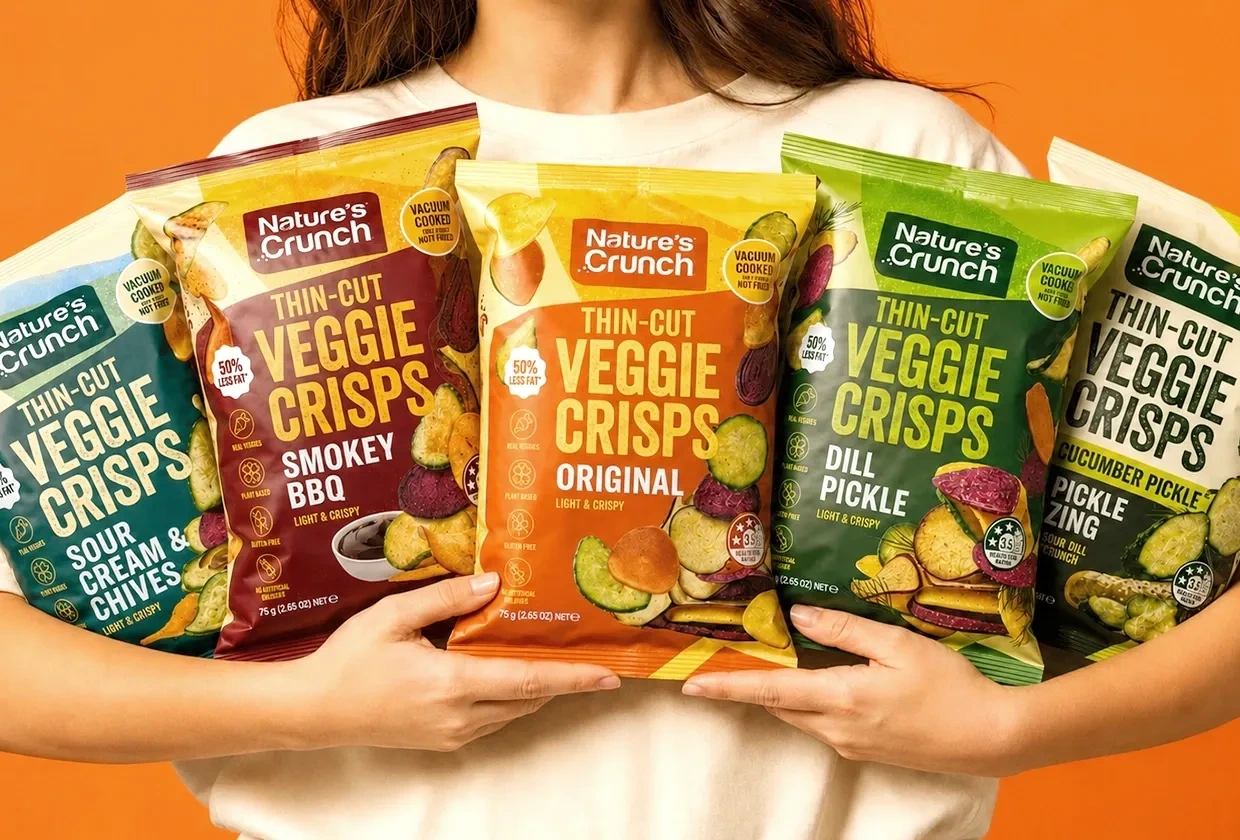
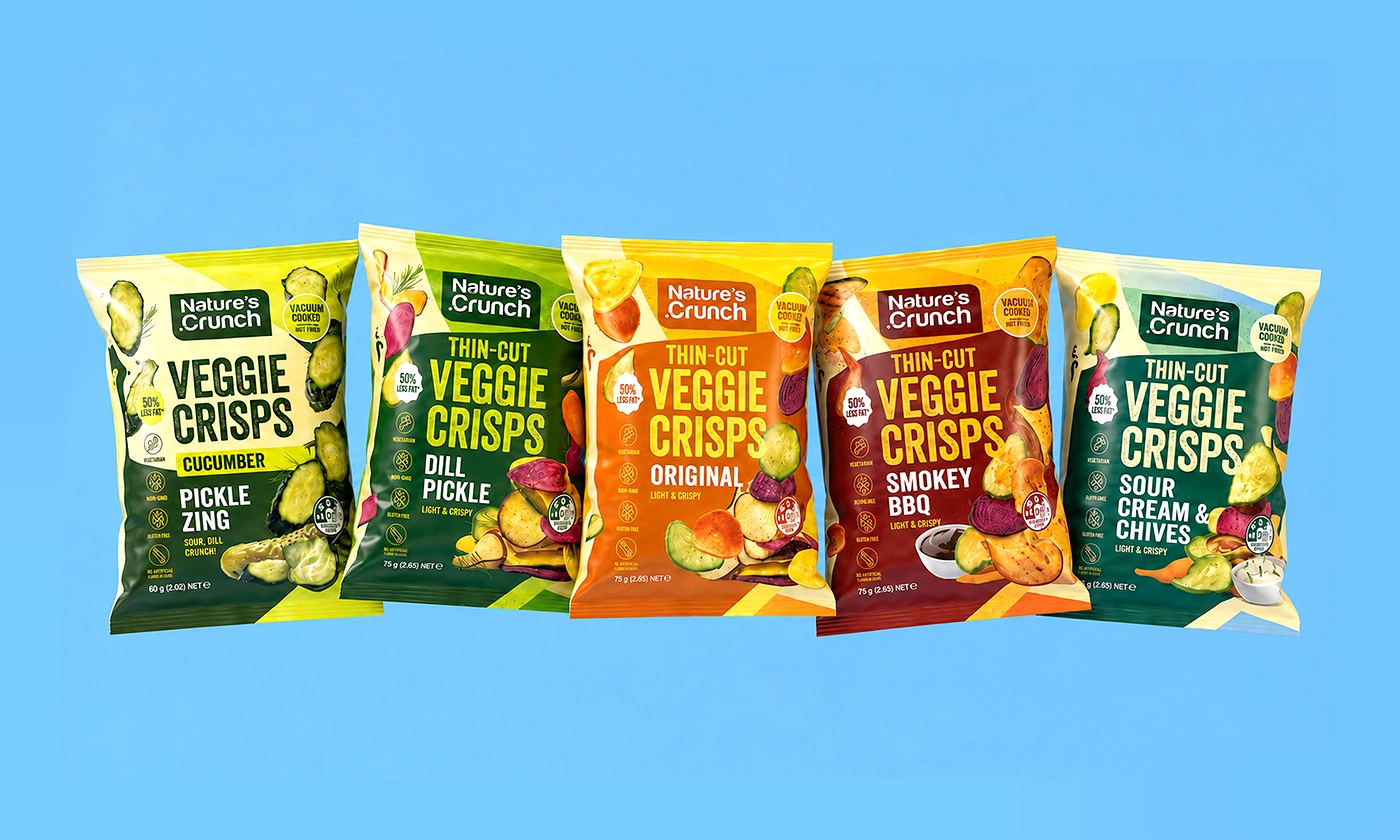
For the Nature’s Crunch veggie crisps line, the range had five SKUs: Original, Dill Pickle, Smokey BBQ, Sour Cream & Chives, and Cucumber Pickle Zing. The packs had to stand out in a busy snack aisle while still reading as one family, and each had to get the product, the flavor, and the main benefits across quickly without feeling crowded. The solution was a shared layout with color-coding by flavor across all five. The same brand’s sweet potato crisps had to work across two formats, an individual pack and a retail box of six. That’s the reason section 8 asks for every format up front.
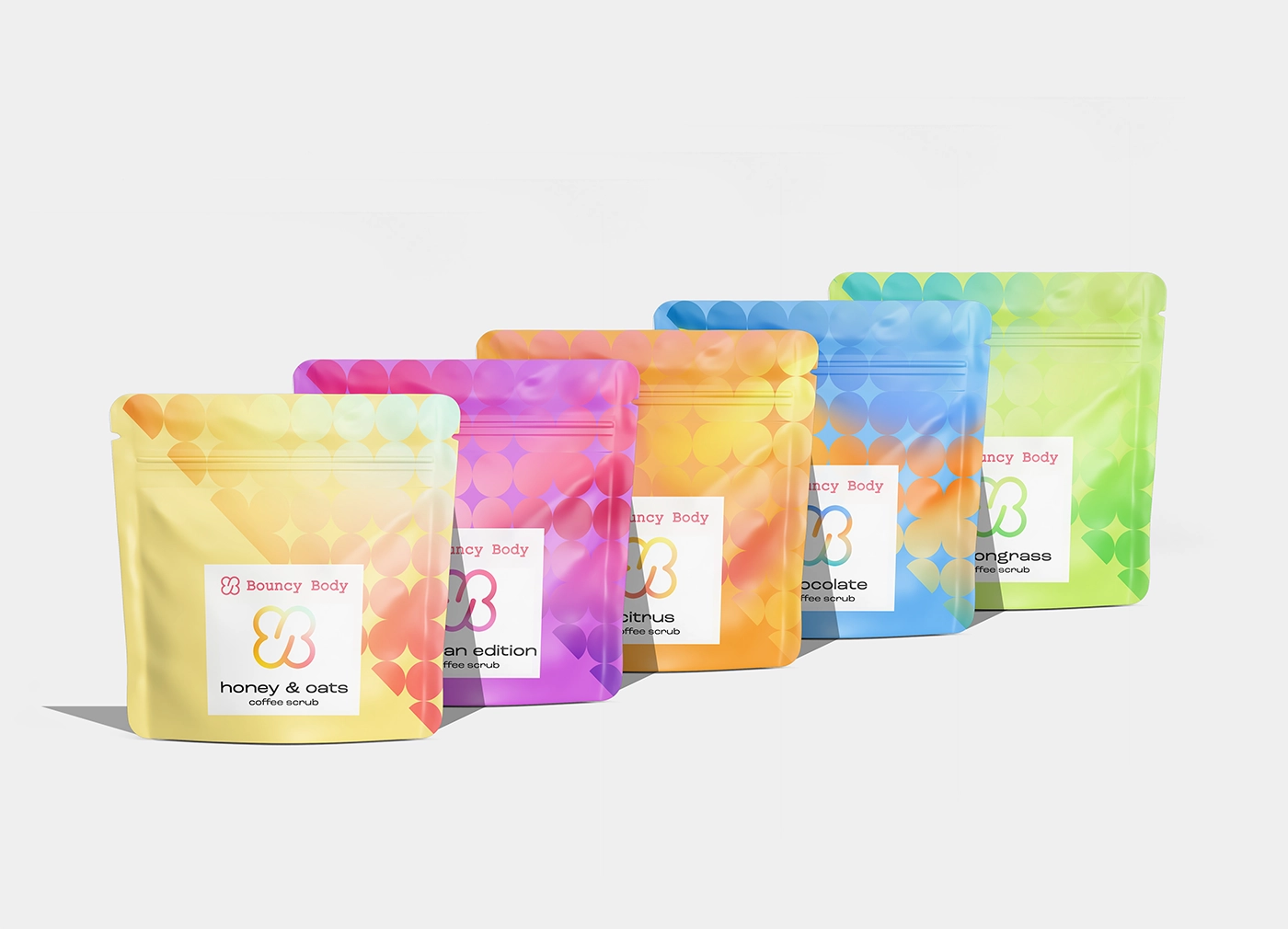
The Bouncy Body coffee scrubs come in stand-up zipper pouches, and the requirements were practical. Each SKU had to be clearly different within one system. The pouches had to work in a humid bathroom, look good in photos and on social media, and stay within a packaging budget that made sense for both direct-to-consumer and retail.
Brief mistakes that cost revision rounds
Each of these is easy to miss, and any one of them can use up a revision round.
- Prescribing the solution instead of the problem. “Make it green with a leaf” closes off better answers. “Shoppers need to see that it’s plant-based in two seconds” lets the designer find the best way to show it.
- Adjectives without examples. “Modern, clean, premium, fun” means something different to every reader. Attach packs you like and packs you don’t. A few photos say more than any list of adjectives.
- No message hierarchy. Six claims on the front at the same volume means the shopper notices none of them.
- Sending a brand book as the brief. Twenty pages of brand story that never mention the SKU count, the pack format, or the dieline.
- Changing the brief after the concepts arrive. New flavors, a new channel, or a new price point after round one means the concepts were designed for a different project. If the brief changes, say so and expect the scope to change with it.
- Gaps covered above: no competitor photos, placeholder copy, no dieline, no single decision-maker, no budget range.
What happens after you send us a brief
Your brief doesn’t have to be perfect. Send what you have, and we’ll follow up by email (sometimes with a short call) on anything that’s still open.
Once we’ve reviewed it, you get a fixed estimate within 1–2 business days, and we don’t bill by the hour. Our packaging design services start at $2,500 and label design at $1,500. Either one comes with three concepts and three rounds of revisions, and most projects go from kickoff to final files in two to three weeks.
Our studio is based in Albany, New York. We’ve spent more than 10 years on branding and packaging and have done 80+ packaging projects for consumer brands across the US, most of them in food and beverage. Since we don’t print, we build your files on your printer’s dieline, and they’ll run with whichever printer you pick.
ready to brief your packaging?
send us your brief, even a rough one: fixed estimate in 1–2 business days, design only, any printer
get quoteFAQ
01 How long should a packaging design brief be?
One to three pages is enough for most projects. Coverage matters more than length. A one-page brief that answers all ten sections is more useful than a ten-page brand book that never mentions the dieline or the SKU count.
02 Who should write the packaging design brief?
The founder or the marketing lead usually owns it, but they need input from whoever handles operations, because the printer, the dieline, the quantities, and the required copy usually live with that person. Pick one owner to collect the answers and make sure the brief is complete.
03 What if I don’t know my budget yet?
Say so, and give the designer whatever constraint you do know, such as your total launch budget or the price you hope to sell at. A good designer will then show you options at different scopes. Our guide to packaging design costs can also help you set a realistic range before you write the brief.
04 What are the 5 P’s of packaging?
There’s no single official list. One widely used version names five jobs a pack does: promote, position, present, provide, and protect. It makes a handy checklist. If your brief explains how the pack should promote and position the product, how it should present it, what information it has to carry, and what it needs to protect, you’ve covered the essentials.
05 What are the 3 C’s of packaging?
You’ll find several versions. One is convenience, communication, and cost. Another, from Dell’s sustainable packaging program, is cube, content, and curb. Either way, they point to questions your brief should answer: how the pack is used, what it has to say, and what it can cost to produce.
06 What is an example of a design brief?
A packaging design brief covers ten areas, from product and buyer to required copy, production, budget, and approvals. The filled-in Ridgeline Granola example above shows what each section looks like with real answers.
07 Can a designer help me write the brief?
Yes, and most good studios will. If you’re not sure how to answer a section, send what you have and ask. At SOTDESIGN we follow up on anything missing, sometimes with a short call, before we send the estimate.
08 Is a packaging brief the same as a creative brief?
No. A creative brief covers the message and the feeling for any channel. A packaging brief includes that and adds the physical facts: pack format, sizes, required copy, the printer’s dieline, and production details. A creative brief can be complete and still leave the designer unable to start the packaging.